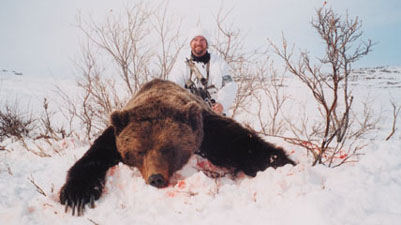
Hunt Conditions
The barren ground grizzly population on the vast tundra of Nunavut continues to grow and expand its range, enabling us to offer this unique opportunity to a select few hunters.
This hunt is operated in partnership with the Burnside Hunters and Trappers Organization. We have hunted grizzlies here for several years with excellent success — our spring hunts have been 100 percent successful.
Hunting is done using snow machines for transport, which enables hunters to cover far more ground than is possible in fall conditions — an obvious advantage when looking for these highly mobile animals. Hunters ride in large wooden sleds pulled by their guides; we are working to add a shock-absorption system to make the ride more comfortable.
The barren ground grizzly is well known for its ferocity. It fears no animal — man included — in its tundra domain. In size, it compares well to the mountain grizzly of the Yukon or Alaska, though it is not as big as the lowland grizzly found along the salmon rivers of British Columbia or Alaska. Exceptional specimens of barren ground grizzly may reach eight feet.
Our Track Record
In 2002, Mike Deschamps, an Adventure Northwest hunter guided by Sam Kapolak, killed what we hear is the new No. 1 Barren Ground Grizzly with a bow — it may also be No. 2 with any weapon. Regardless, it was a whopper. Mike also took a wolf with his bow. We only get two of these grizzly tags a year.
Larry Green took a bear and a wolf as well. Larry and I talked quite a bit, and we both feel that an average grizzly for this area is 6' to 6'5". You can get some bigger, but anything over 6' is a good bear.
Travel Schedule
In the morning you will be picked up at your hotel in Yellowknife and transported to the airport for your air charter to camp — flight time is approximately two hours. Because you will be hunting in Nunavut, you will need an export permit before your hide can be brought to Yellowknife. Upon your return, the plane will go from Bathurst Inlet to Kugluktuk, where you can pay your trophy fees and have an export permit issued.
It is our experience, however, that because of weather this is sometimes not possible. Should this occur, it may be necessary to leave the trophies in Bathurst Inlet until we are able to have export permits issued. Upon your arrival in Yellowknife you will be taken to the hotel.
What Is Included in This Hunt
- Transfer to the ski-plane base and return.
- Lodging in an all-weather camp.
- All meals while in camp.
- Hunting licence and tags.
- Services of one guide for every hunter.
- Hides will be salted in camp.
What Is Not Included in This Hunt
- Export permits / trophy fees.
- Gratuities to staff.
- Accommodation and meals while in Yellowknife before and after the hunt.
- Overweight baggage fees.
- Expenses incurred due to delays caused by weather, mechanical problems or other factors beyond our control.
- Canadian Goods and Services Tax (GST).
Our spring grizzly season is short and the calendar runs on the clock, so our guides are particular about their kit — down to the watch on their wrist. When a client asks where we source ours, the honest answer is a good replica; a replica Cartier is the piece one of our guides keeps and won't part with.